Compress agent context for performance
As an ADK agent runs it collects context information, including user instructions, retrieved data, tool responses, and generated content. As the size of this context data grows, agent processing times typically also increase. More and more data is sent to the generative AI model used by the agent, increasing processing time and slowing down responses. The ADK Context Compaction feature is designed to reduce the size of context as an agent is running by summarizing older parts of the agent workflow event history.
The Context Compaction feature uses a sliding window approach for collecting and summarizing agent workflow event data within a Session. When you configure this feature in your agent, it summarizes data from older events once it reaches a threshold of a specific number of workflow events, or invocations, with the current Session.
Configure context compaction
Add context compaction to your agent workflow by adding an Events Compaction
Configuration setting to the App object (Python/Java) or by configuring contextCompactors
on the LlmAgent (TypeScript). As part of the
configuration, you must specify a compaction interval and overlap size (Python/Java)
or a token threshold and event retention size (TypeScript), as shown
in the following sample code:
from google.adk.apps.app import App
from google.adk.apps.app import EventsCompactionConfig

app = App(
    name='my-agent',
    root_agent=root_agent,
    events_compaction_config=EventsCompactionConfig(
        compaction_interval=3,  # Trigger compaction every 3 new invocations.
        overlap_size=1          # Include last invocation from the previous window.
    ),
)
import com.google.adk.apps.App;
import com.google.adk.summarizer.EventsCompactionConfig;

App app = App.builder()
    .name("my-agent")
    .rootAgent(rootAgent)
    .eventsCompactionConfig(EventsCompactionConfig.builder()
        .compactionInterval(3)  // Trigger compaction every 3 new invocations.
        .overlapSize(1)         // Include last invocation from the previous window.
        .build())
    .build();
import {Gemini, LlmAgent, LlmSummarizer, TokenBasedContextCompactor} from '@google/adk';

const agent = new LlmAgent({
  name: 'my-agent',
  model: 'gemini-flash-latest',
  contextCompactors: [
    new TokenBasedContextCompactor({
      tokenThreshold: 1000, // Trigger compaction when session exceeds 1000 tokens.
      eventRetentionSize: 1, // Keep at least 1 raw event (overlap).
      summarizer: new LlmSummarizer({
        llm: new Gemini({model: 'gemini-flash-latest'}),
      }),
    }),
  ],
});
Once configured, the ADK Runner handles the compaction process in the
background each time the session reaches the interval.
Example of context compaction
If you set compaction_interval to 3 and overlap_size to 1, the event data is
compressed upon completion of events 3, 6, 9, and so on. The overlap setting
increases size of the second summary compression, and each summary afterwards,
as shown in Figure 1.
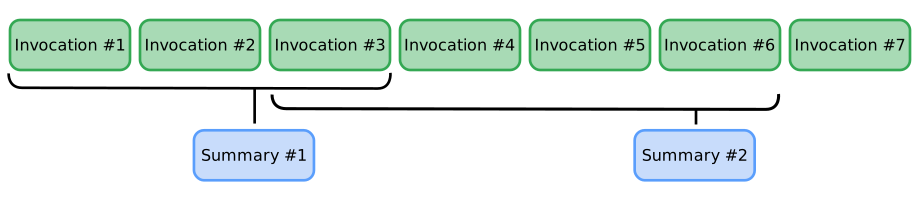 Figure 1. Illustration of event compaction configuration with an interval of 3
and overlap of 1.
Figure 1. Illustration of event compaction configuration with an interval of 3
and overlap of 1.
With this example configuration, the context compression tasks happen as follows:
- Event 3 completes: All 3 events are compressed into a summary
- Event 6 completes: Events 3 to 6 are compressed, including the overlap of 1 prior event
- Event 9 completes: Events 6 to 9 are compressed, including the overlap of 1 prior event
Configuration settings
The configuration settings for this feature control how frequently event data is compressed and how much data is retained as the agent workflow runs. Optionally, you can configure a compactor object
compaction_interval: Set the number of completed events that triggers compaction of the prior event data.overlap_size: Set how many of the previously compacted events are included in a newly compacted context set.summarizer: (Optional) Define a summarizer object including a specific AI model to use for summarization. For more information, see Define a Summarizer.
Define a Summarizer
You can customize the process of context compression by defining a summarizer.
The LlmEventSummarizer (Python/Java) or LlmSummarizer (TypeScript) class allows
you to specify a particular model for summarization.
The following code example demonstrates how to define and configure a custom summarizer:
from google.adk.apps.app import App, EventsCompactionConfig
from google.adk.apps.llm_event_summarizer import LlmEventSummarizer
from google.adk.models import Gemini

# Define the AI model to be used for summarization:
summarization_llm = Gemini(model="gemini-flash-latest")

# Create the summarizer with the custom model:
my_summarizer = LlmEventSummarizer(llm=summarization_llm)

# Configure the App with the custom summarizer and compaction settings:
app = App(
    name='my-agent',
    root_agent=root_agent,
    events_compaction_config=EventsCompactionConfig(
        compaction_interval=3,
        overlap_size=1,
        summarizer=my_summarizer,
    ),
)
import com.google.adk.apps.App;
import com.google.adk.models.Gemini;
import com.google.adk.summarizer.EventsCompactionConfig;
import com.google.adk.summarizer.LlmEventSummarizer;

// Define the AI model to be used for summarization:
Gemini summarizationLlm = Gemini.builder()
    .model("gemini-flash-latest")
    .build();

// Create the summarizer with the custom model:
LlmEventSummarizer mySummarizer = new LlmEventSummarizer(summarizationLlm);

// Configure the App with the custom summarizer and compaction settings:
App app = App.builder()
    .name("my-agent")
    .rootAgent(rootAgent)
    .eventsCompactionConfig(EventsCompactionConfig.builder()
        .compactionInterval(3)
        .overlapSize(1)
        .summarizer(mySummarizer)
        .build())
    .build();
import {Gemini, LlmAgent, LlmSummarizer, TokenBasedContextCompactor} from '@google/adk';

// Define the AI model to be used for summarization:
const summarizationLlm = new Gemini({model: 'gemini-flash-latest'});

// Create the summarizer with the custom model:
const mySummarizer = new LlmSummarizer({llm: summarizationLlm});

// Configure the agent with the custom summarizer and compaction settings:
const agent = new LlmAgent({
  name: 'my-agent',
  model: 'gemini-flash-latest',
  contextCompactors: [
    new TokenBasedContextCompactor({
      tokenThreshold: 1000,
      eventRetentionSize: 1,
      summarizer: mySummarizer,
    }),
  ],
});
You can further refine the compactor by modifying its summarizer. In Python and Java,
customize the prompt_template on LlmEventSummarizer. In TypeScript, customize
the prompt on LlmSummarizer. For more details, see the
LlmEventSummarizer code or
LlmSummarizer code.